

We frequently field questions from owners of tonearms with "non-standard" mounting geometry.
Examples include Jelco, Ikeda, Fidelity Research, SAT, Well Tempered, etc.
They're "non-standard" in the sense that commonly available protractors are typically designed for Baerwaald, Löfgren, Stevenson, and (sometimes) Uni-DIN alignments.
Note that the ubiquitous Feickert protractor accommodates the first three alignment protocols.
Why this Matters - the TL;DR
If you're short on time, link down to our Final Thoughts section for a summary of this analysis.
As always, we're more than happy to discuss this with you on a one-on-one basis.
A few quick takeaways:
- If you have a fixed-mount turntable, your mounting location may limit the alignment geometry you can experiment with. Baerwaald, Löfgren, Stevenson alignments may not be possible with some of the above referenced tonearms.
- This can be a problem if the manufacturer doesn't supply a protractor for the tonearm.
- Many of these non-standard geometries can be "good enough", but the problem lies in sourcing a protractor to perform the alignment.
- In some cases, we are able to establish viable mounting parameters (and a protractor) for these arms.
Some Background
In general (there are exceptions), many of the classic Japanese designs hold the overhang constant over a range of effective lengths.
For example, the 229mm Jelco, the Fidelity Research FR64 series, and the Ikeda Model 345 (245mm long) all specify an overhang of 15mm.
In many cases, the geometry isn't specified (apart from effective length and overhang) and a protractor isn't provided.
In contrast, the math developed by Löfgren (and subsequently used by Baerwaald), derives a unique set of 3 parameters (effective length, mounting distance and offset angle) for each and every effective length. In other words, no two effective lengths have an overhang of 15 mm.
Protractors for Baerwaald are readily available, and slightly less so for Löfgren, Stevenson and Uni-DIN.
In Example-4 below, we model the cartridge re-positioning required to align a Jelco for Baerwaald, after it has been mounted to Jelco's specification. The cartridge needs to be moved forward in the headshell by nearly 3mm to achieve a Baerwaald alignment and slightly more for a Löfgren setting!
As Clint Eastwood once said: "do you feel lucky?"
Disclaimer:
There's much disagreement over the ideal alignment geometry for pivoting arms, and enough has been written about this, so we won't cover it here. We'll mount your arm any way you wish.
Suffice to say, a majority of individuals opt for Baerwaald, since the math is optimized to minimize average distortion across the entire LP.
Ultimately, this is your decision and there's no wrong answer. Some of the alternate models we map out below are quite good.
We want you to understand the pitfalls, and it's our hope that this analysis helps you make a more informed decision before drilling into your armboard (or worse) through your turntable base.
What? You want charts? We'll give you charts!
Pull up a seat and pour a cup. This is going to massage your brain cells ...
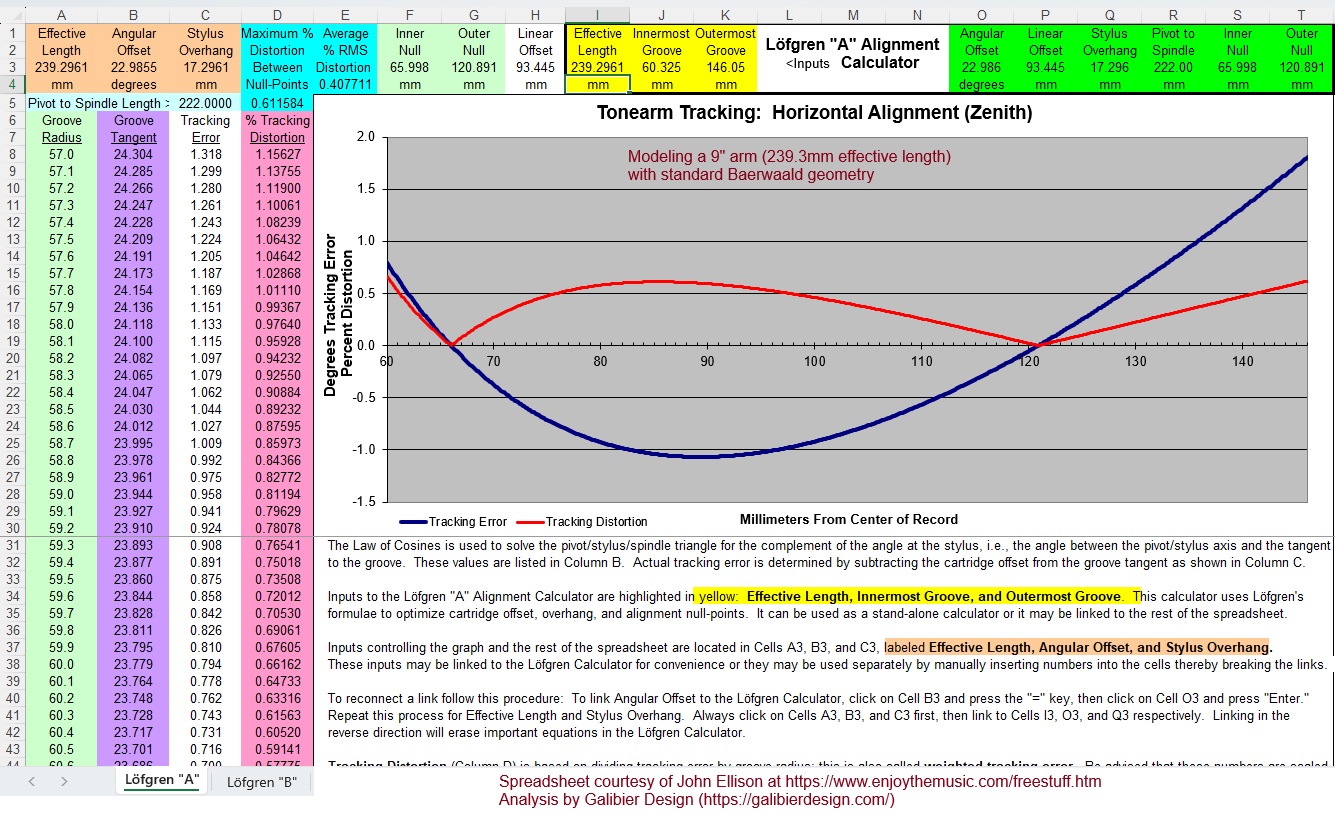
One of the best resources on the web for establishing tonearm parameters and mount points is a spreadsheet developed by John Ellison which is posted in the "Free Stuff" section of the Enjoy the Music website.
We maintain a link to that page on our "main Support Page".
Here's the direct link to the download. Scroll to the bottom of the page for the download and instructions.

Next up ... some background on the Ellison spreadsheet. Skip to Example-1 if Excel isn't your jam.
You might want to download the screen captures (below) as you will find yourself comparing them. Click to expand them to full-screen before downloading.
Ellison Spreadsheet - a Quick Excel Lesson
The Ellison spreadsheet has two worksheets.
- The first one is for the Baerwaald math (labeled Löfgren A)
- The second one is for Löfgren (labeled Löfgren B).
We'll use Baerwaald/Löfgren A in these examples and a 245mm effective length for most of them in order to model the Ikeda's 245 / 15mm specification (also the Fidelity Research FR 64 series).
- The simplest use case involves entering the effective length in cell I-3.
- The results are displayed in the tan cells A-3, B-3, C-3, and the blue cell C-5 (effective length, offset/zenith, overhang, pivot-spindle).
- These four cells "drive" the distortion and tracing error graph. If you "speak Excel", note that the values in A-3, B-3, and C-3 are cell references to calculations (A-3=I-3, B-3=O-3, C-3=Q-3).
- You can "break" these links to model the geometry of your choosing by keying values directly into cells A-3, B-3, and C-3.
In the examples below, we set the cell precision to 4 decimal places which is unnecessary in normal use.
We use this precision level it to iteratively work "backwards" to find an effective length from a pre-determined pivot to spindle distance. We used this in Example-4 to to find the effective length that results in Jelco's pivot to spindle distance of exactly 214.0000 mm.
Example-1: Standard Baerwaald
This is how you'd mount a Fidelity Research / Ikeda (245mm) arm with your Baerwaald protracot.
In this screen shot, note the outputs in cells A-3 (repeating the effective length), B-3 (offset/zenith), C-3 (overhang) and C-5 (which re-calculates pivot-spindle, using effective length & pivot-spindle).

Ideal Setup
Note the peak distortion is generally below .5% across the entire LP. Baerwaald was developed to minimize average distortion across the entire LP.
Also note that the Baerwaald overhang (16.8632) is nearly 2mm longer than Ikeda's 15mm specification!
We'll model both the Ikeda and Jelco factory spec below. Compare this example against the Ikeda and Fidelity Research example (Example-3, below).
Example-2: Overhang Error (1mm too long)
So you casually aligned, and your cartridge is 1mm "forward" of the Baerwaald ideal.
- Peak distortion drops
- The range between the null points narrows to about 76 & 113mm
- Distortion is reasonably well-behaved between the lead-in groove and the outer null point
- Distortion rises dramaticaly from the inner null point to the end of the record.

Overhang Error - 1mm Long
If you have basic Excel familiarity with cell references, model this error by manipulating cells A-3 and C-3.
We added 1mm to both of these cells. Refer to the comments on the screen shot.
Example-3: Ikeda 345 / Fidelity Research FR64
The effective length (245) and pivot-spindle (230) are published for both the Ikeda and Fidelity Research. The offset angle is not documented.
A customer sourced a protractor for his Fidelity Research FR64S, although its veracity has not been confirmed. It specifies an offset angle of 21.5 degrees.
We also don't know if Ikeda changed the spec from the original FR64 series.
Left Graph (FR64 "Error")
This is a bit of a straw man, in that you'd never accidently align this way.
We modeled standard Baerwaald recommendation (from example-1, above) and then reduced the overhang (from 16.8362 to 15mm) by editing cell C-3..
It shows the effect of varying the overhang from "Baerwaald standard". The results are not pretty.
Right Graph (FR64 "Spec")
This graph applies the The FR64 "Spec" from our customer's protractor.
- We started with the same effective length of 245mm (cell I-3)
- We overrode the angular offset to 21.5 degrees (cell B-3)
- We overrode the overhang to 15mm (cell C-3)
The difference between the two examples is the offset angle.

FR64 "Error"

FR 64 "Spec"
Comparing the FR64 "Spec" against Example-1, above:
- The "FR 64 Spec" version has no inner null point!
- The "FR 64 Spec" version has quite a bit higher distortion than ideal Baerwaald (Ex-1).
- The "FR 64 Spec" version is otherwise nearly as good as ideal Baerwaald (Ex-1).
Comments:
We're not quite sure what to make of the veracity of the "Spec" geometry, given that Ikeda specifies a distortion range of +2° – 1°21′ for the current tonearm. The "Spec" geometry modeled above is quite a bit better than this.
Is the "Spec" geometry the result of someone's experimentation to improve the original FR64 alignment, or alternatively, did Ikeda make some changes for the worse? Or both?
Two things are clear however:
- All three parameters (eff. length, pivot-spindle, offset angle) work in concert with each other.
- Zenith (offset angle) matters, and you can compensate for undocumented mounting specs by experimenting with offset angle (zenith).
The FR64 "Spec" alignment may not be everyone's cup of tea (which alignment is?), but it certainly has reasonable distortion characteristics.
As noted above, a key consideration is whether you can source a dedicated protractor to meet the above specification (21.5 degree offset angle), and whether it's manufactured accurately.
Example-4: Jelco "Error"
This is another arm with a "standard" 15mm overhang - this time, with a 229mm effective length.
- This example illustrates how mounting to the manufacture's recommendations may prevent you from achieving a Baerwaald alignment. You might run out of forward adjustment range in your headshell.
- If you mounted it to specs (i.e. 214mm) and later wanted to align for Baerwaald, you would have to move the cartridge forward in the headshell by 2.8935mm (nearly 3mm!). A Löfgren alignment would extend the mount further by approximately .5mm.
- We also experimented using the standard 229/214 parameters and varied the offset angle with encouraging results (middle graph, below) - similar to the FR/Ikeda example above.
First (Left) Graph (Jelco "Error")
This is like the FR64 "error" example, above.
- We modeled for Baerwaald (keying 229mm into cell I-3)
- We overrode the overhang to 15mm (cell C-3)
Middle Graph ("Proposed Offset Angle Correction")
This is similar to the FR64 "Spec" example, above.
- We modeled for Baerwaald (keying 229mm into cell I-3)
- We overrode the overhang to 15mm (cell C-3)
- We guessed at an offset angle of 21.5 degrees (no protractor or specification was available).
Note the similarity to the FR64 "Spec" graph, above.
The null points are a bit closer together in comparison with the Baerwaald alignment, and distortion is under .5% within these bounds. At the lead-in groove side, maximum distortion is a bit over 1%.
Right Graph (Jelco Baerwaald Alignment)
This is the situation you would face if your Jelco was mounted to the 214mm spec and you used your Baerwaald protractor to align your cartridge.
For this example, we expeimented with cell I-3 to find an effective length that results in a 214m pivot to spindle distance.
The required effective length is 231.8935 mm (cell I-3) - nearly 3mm longer than the 229mm specification.
Note that we mount Jelcos at the "Kuzma distance" of 212mm and this yields a cartridge position that's "shorter" and is very close to the mounting slot centers.
Comment:
As with the Ikeda (above), we haven't found a documented offset angle specification, but experimentation shows promise. Of course, we have not found a "Jelco spec" protractor.
Are you beginning to see why mounting your tonearm to permit a Baerwaald is a safe choice - especially when you take protractor procurement into consideration?

Jelco "Error"

Proposed Offset Angle Correction

Jelco Baerwaald Alignment
Modeling Zenith Error:
Zenith is the new azimuth ... right?
The following two examples model a zenith variance that is within cartridge manufacturers' specs of +/- 2 degrees.
If you align your cantilever to your protractor, but your stylus assembly has errors of 1 or 2 degrees, these are the results. See why zenith matters?

1 deg. CW Zenith Error

2 deg. CW Zenith Error
Compound Errors
OK ... you fired up your AnalogMagik and nailed both azimuth and zenith. Huzzah!
In order to optimize zenith, you had to rotate the cartridge in the headshell, and you invariably changed the overhang. We feel your pain.
With a traditional two-bolt headshell mount, you'll find yourself pivoting the cartridge back and forth on one of the two bolts, and you may find your overhang has changed by as much as a mm or two.
In this example, we modeled a tonearm with a Schröder style cartridge mount.
The cartridge pivots about a central bolt instead of the cartridge's two mounting bolts. This helps you more easily maintain your overhang setting. While not perfect, it does simplify tuning azimuth.
Below, our our CAD model shows the effect of a 2 degree cartridge rotation on effective length / overhang. The effective length is shortened by only .120mm. The graph shows the minimal impact of this overhang error.
We'll let you decide whether it's worth your time to iteratively adjust overhang as well as zenith to get both parameters "spot on".
One thing is clear however: A zenith error has much more impact than a slight overhang error. Thank goodness for the little things.

Overhang Effect

0.120mm Overhang Error
9 vs. 12: is longer better?
This may be the most frequent question we receive.
From the perspective of tracing distortion, a long (12") arm has no significant superiority over a short (9") arm. None!
Go long if you your table architecture requires it, if you like the look, or if the arm of interest is a "mass match" for your collection of cartridges, but don't fool yourself into thinking that there are any meaningful advantages due to the geometry of a longer arm.
This simulation below compares a 9" arm (Rega length - 239.3mm) and a 12" arm (310mm).
239mm Arm / Baerwaald

310mm Baerwaald
Final Thoughts
Experiment
Don't judge a tonearm design until you've revisited your setup, and tried a proven geometry, paid attention, and used precision setup tools. While obvious, this bears repeating.
Choosing an alternate alignment may unlock your arm's potential.
Having said that, we can't begin to enumerate how many times someone has reported an improvement by changing from "A" to "B", only to return to "A" and notice yet "another" improvement.
We attribute this as much to the randomness of setup errors, as much as to the the psychology of A/B testing. The lesson here is to pay attention.
Control your destiny:
Armed with the Ellison spreadsheet, you can determine and mount to Baerwaald or Löfgren geometry, as long as your tonearm allows for you to adjust offset angle (zenith).
In all likelihood, you can accommodate some of the above "vintage geometries", allowing for all of the choices you'll ever want to try.
Using the Ellison spreadsheet, key in the arm's effective length as the starting point.
Caveat: we found one popular tonearm who's effective length was misstated. We can show you how to determine/verify your arm's true effective length.
Cartridge Variance
Unfortunately, the position of the stylus relative to the mounting bolt holes is non-standard. This has an effect on the effective length of your setup, and is one reason for providing adjustment slots in headshells.
Statistically, the mean distance hovers around 9.25mm (Lyra, Hana, My Sonic Lab, ZYX, and many other cartridges).
To help you visualize this, here's a drawing of the Dynavector XV-1s/XV-1t (courtesy of Dynavector). Note the 8.00mm stylus offset (one of the shortest ones we've encountered):

XV-1t and XV-1s (click to enlarge)
Use your common sense:
You will hear claims from tonearm designers that adjustment features like azimuth (and even zenith!) should not be necessary - that it's the cartridge manufacturer's responsibility to deliver a perfectly aligned cartridge.
This is is an unrealistic expectation, and the reason designers implemented adjustment features in the first place! If you'd like to read more about the limitations of cartridge manufacturing, read Jonathan Carr of Lyra's comments on the topic. Jonathan is one of the "good guys" in our industry.
Azimuth
Azimuth adjustment is beyond the scope of this article. Suffice to say that it's an important setup parameter.
Zenith & adjustable offset angle:
Refer back to the zenith section if you have any doubts about it's importance. Fortunately, arms without this feature are very rare. Among the exceptions are the modern SMEs (models IV & V) and the Well Tempered arm.
Zenith is the "new azimuth". Experimenting with it matters ... a lot! This bears repeating.
Tradeoffs
Correcting a zenith error at the expense of a slight overhang error is a worthwhile tradeoff if you have to make it.
Of course, we prefer to get everything "perfect", but at the same time, it's comforting to know what you can prioritize and address over time (not in one session). Your patience will be rewarded. Refer to the "Compound Errors" section above.
Your opinion matters!
The only correct geometry (and setup) is the one you like, but remember, you won't know better until you hear it.
Plan:
Planning for mounting flexibility isn't rocket science, but if you have any doubts or questions, reach out to us.
Disinformation
Here at Galibier, we're all about slaying the sacred cows. Most of the disinformation we encounter is well-intentioned and is by no means nefarious, but the effect is the same.
We run the risk of offending some, and we'll leave it to you to judge.
We've worked long and hard at this over the decades, and we recognize that no single individual is the repository of absolute knowledge. Neither Galibier, nor anyone else is the final arbiter of truth.
With that in mind, one of our guiding principles with respect to vinyl playback is WWFD: (what would Frank do). We're referring to Frank Schröder and Franc Kuzma - two of the most level-headed thinkers we've encountered in the vinyl playback realm.
AnalogMagik Note
The AnalogMagik test record has a multi-use track used for establishing azimuth, zenith, and VTA.
The end of this track is near the outer null point, so the distortion measurements will not compound as they would if the track was located near the center of the record.

