
The Niwatt Amplifier - Not Your Grandfather's 300B
10 years in development ... we challenge any amplifier at ANY price
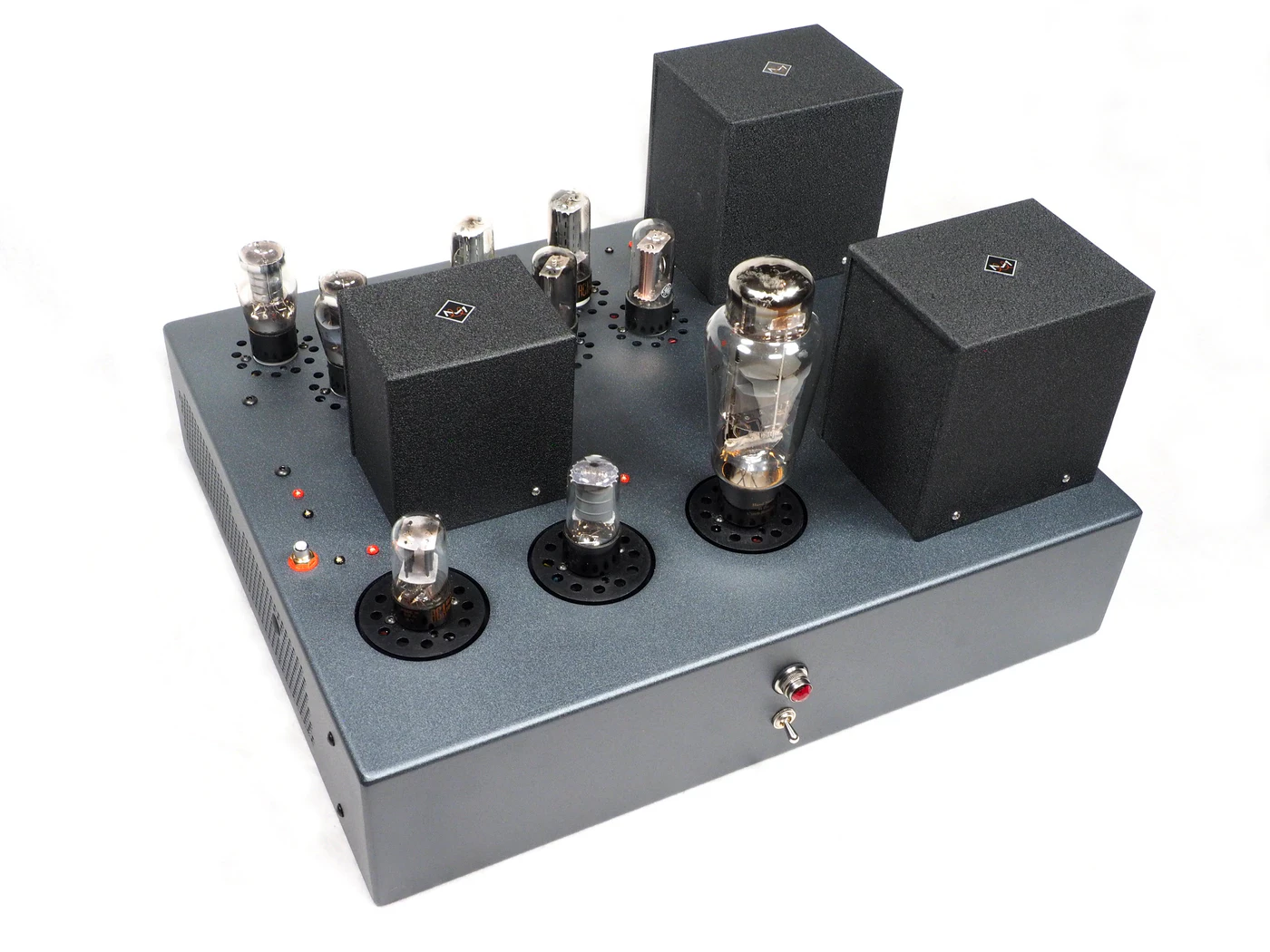
(click to enlarge)
This is a bold claim and we're not asking you to take our word for it.
After visiting systems with speakers which would be considered ideally compatible with a 300B as well as systems one would never dream of pairing with a 300B with, it's a statement we're prepared to back up.
If you love the tonal beauty of the 300B tube, but long for more dynamic authority, clarity and rhythmic speed, the NiWatt is your amplifier.
If you are conflicted between the delicacy and beauty of a type 45 or 50 tube, and the sense of unrestrained power of a 20 watt 845, the NiWatt is your amplifier.
The NiWatts are not a typical product, and this is not a typical product page.
If you're looking for flowery prose, go somewhere else.
This project has been a labor of love, taking nearly a decade to come to realization.
In the technical narrative below, we will try to convey our design philosophy and the rationale behind our design decisions without relying on complex technical language.
For readers and customers with a strong background in electronics, we are happy to discuss any of these decisions personally — we welcome that conversation.
We respect your intelligence and think you deserve no less!
Old Meets New
At every step along this journey, our musical aesthetic and our technical criteria had to be aligned.
The NiWatts couldn't just sound great. They had to be conservatively designed, heirloom quality with "roadie proof" construction - a design which could easily be in service for decades.
As you read the technical details below, take note of the attention we paid to:
- Power supply design
- Circuit layout and grounding
- Parts selection - chosen for performance and not a price point
- The unique (and often overlooked) demands of heating the filament of a directly heated triode
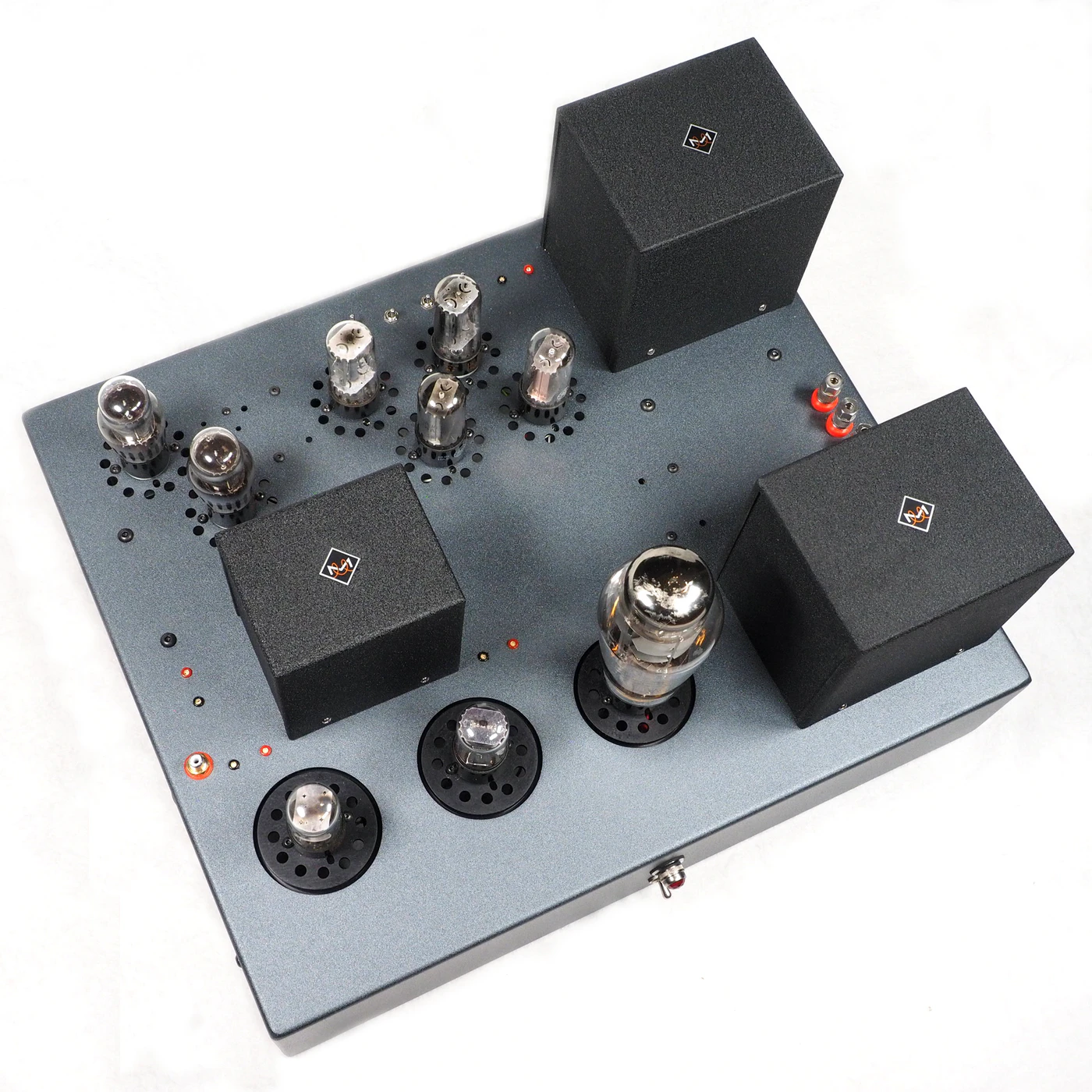
(click to enlarge)

So pour a cup and read on ...
Technical Overview
Mark I? Mark II? Mark X?
Think of this design as the NiWatt Mark X. They have been in development for over a decade, during which time we went through over 50 circuit revisions.
We're quite proud of the design, and your owners manual comes with a schematic, but much of the musical magic comes from the to detail in layout and construction methods. The schematic is important, but only a small part of the story.
Future Proof Design
At every step of the design process, we took a lifetime of service into consideration. Power supply capacitors are radial mount as the industry is moving away from axial mount capacitors.
Our DC filament supply employs capacitors, resistors, and a common mode choke along with Schotky diodes in the bridge rectifier.
The key reason we didn't opt for the excellent Coleman regulator board is out of future service considerations. Will parts be available for a repair to this board in two decades?
The Power Supply
Critics of the syrupy sound of most 300B amplifiers are reacting to flaws in the power supply design and driver circuit.
Tonal beauty is one thing (we like that), but an amplifier that can't follow complex, dynamic music is a non-starter for us.
The NiWatt has two independent power supplies:
- One for the output section (the 300B)
- One for the input and driver section
When passing a Fortissimo (ffff) passage to your loudspeakers, your output section and its power supply are under extreme duress.
With an independent supply for the input and driver sections, they remain unfazed - coasting along with power in reserve.
This is a critical point, because the sound of a directly heated triode is the sound of the driver stage.
read. that. last. sentence. again ...
This is a critical point, and a key to the higher perceived power of the NiWatts.
Why Not Direct Coupling?
For all the benefits of direct coupled amplifiers, each successive gain stage borrows power from its predecessor.
This drawback is a non-starter to us as it sacrifices the dynamic benefits of a dual power supply design we highlight above.
The high quality interstage transformer from Monolith and coupling capacitor from Jupiter have all of the transparency you would ever require to pass the delicate signal from input to output.
Additionally, the single, high quality coupling capacitor allows you to tune the NiWatt's tone colors to taste.
The Critical Driver Stage
The driver stage is another element whose importance is overlooked in many 300B amplifier designs. It must be specified with adequate power in reserve. Without it, the amplifier's ability to respond to dynamic transients is severely compromised.
The challenge of driving the output tube increases with larger directly heated triodes like the 211, 845 and GM70. 300Bs lie somewhere between these tubes and the "flea power" 45s, 50s and 2A3s in this regard.
This is one reason why many individuals prefer 45s, 50s and 2A3s - not because they're better tubes than 300Bs or their larger siblings, but because they're more forgiving of design errors in the driver stage.
We agree with Sakuma's "like drives like" approach: using an output tube (in this case, a 6V6) to drive an output tube (in this case, a 300B). If this topic interests you, this reprint from Sound Practices magazine delves into the topic.
The separate power supply for the driver section means that it's capable of delivering ample current to the output section under all conditions. This contributes to the perception of a dramatic increase in power, dynamics, and control.
The driver section is never under stress.
At this link, read about the NiWatts' encounter with a pair of Von Schweikerts. A 300B amplifier should not be able to drive such an inefficient speaker ... and yet the NiWatts do so (at least when listening at "civilized" listening levels).
It is for this reason that we encourage you to compare the NiWatt with both push-pull 300B amplifiers as well as “transmitting tube” amplifiers like those based on the 211, 845 and GM70 tubes.
We think you’ll be surprised by the NiWatts' authoritative presentation.
Heating the Filaments
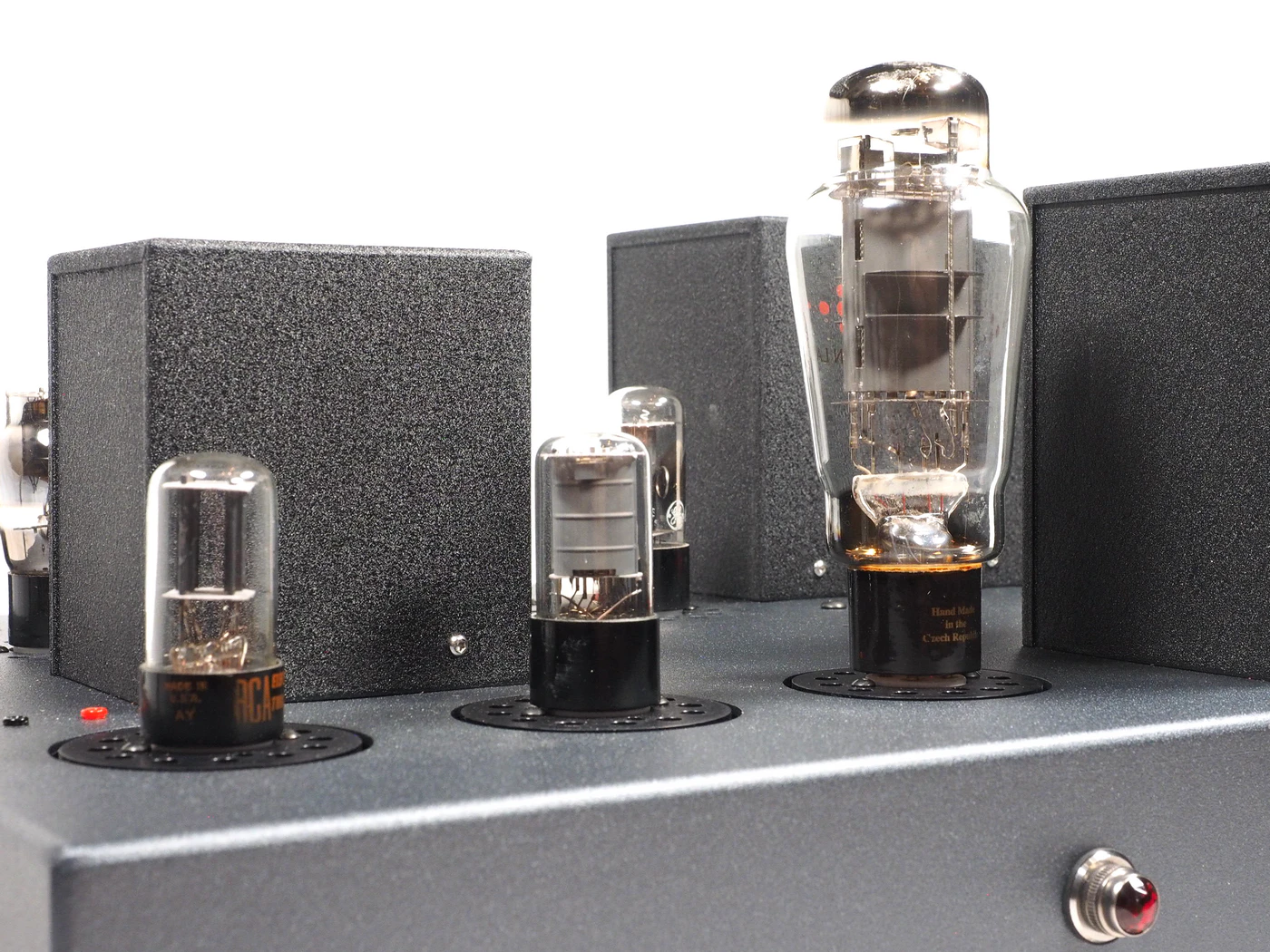
(click to enlarge)
There's been considerable controversy over AC vs. DC heating of directly heated triode filaments. We were previously fans of AC heating for the traditional reasons - its effect on tone, despite the audible hum that a 5 volt filament produces even under ideal conditions.
We almost didn't try DC heating, but in the desire to achieve the best outcome possible we experimented with various DC heating solutions. Many configurations produced what you'd expect: a bleached, or "sanitized" sound.
Over time we arrived as a superior solution - employing a common mode choke in the DC supply. This was quieter without sacrificing textural body. We lost none of the tone colors we sign up for with our triodes.
As we mentioned above, the otherwise excellent Coleman Regulator boards don't meet our criterion of being future-proof (serviceable).
Tuned Filament Supply
Most individuals are unaware of how sensitive directly heated triodes are to filament supply voltage and we know of few designers who pay attention to this critical design consideration.
The Emission Labs site has several technical articles on the subject. This is one of them.
Filament voltage not only dramatically affects tube life, but sonics as well.
Our DC supply is fit with 4 switches which allow you to tune the filament voltage in .06 volt increments (six-hundredths of a volt).
The photo shows the bank of 4 switches - covering a range of 0 to .78 volt adjustment range. To the left, are the red and black test points for monitoring the voltage. They are purposely located at the rear of the amplifier to prevent accidental switching.
The switches will accommodate all 300Bs designed to the Western Electric standard of 1.2 amps filament current. This is the vast majority of 300B tubes.
Refer to the tube section for more details on 300B tube compatibility.
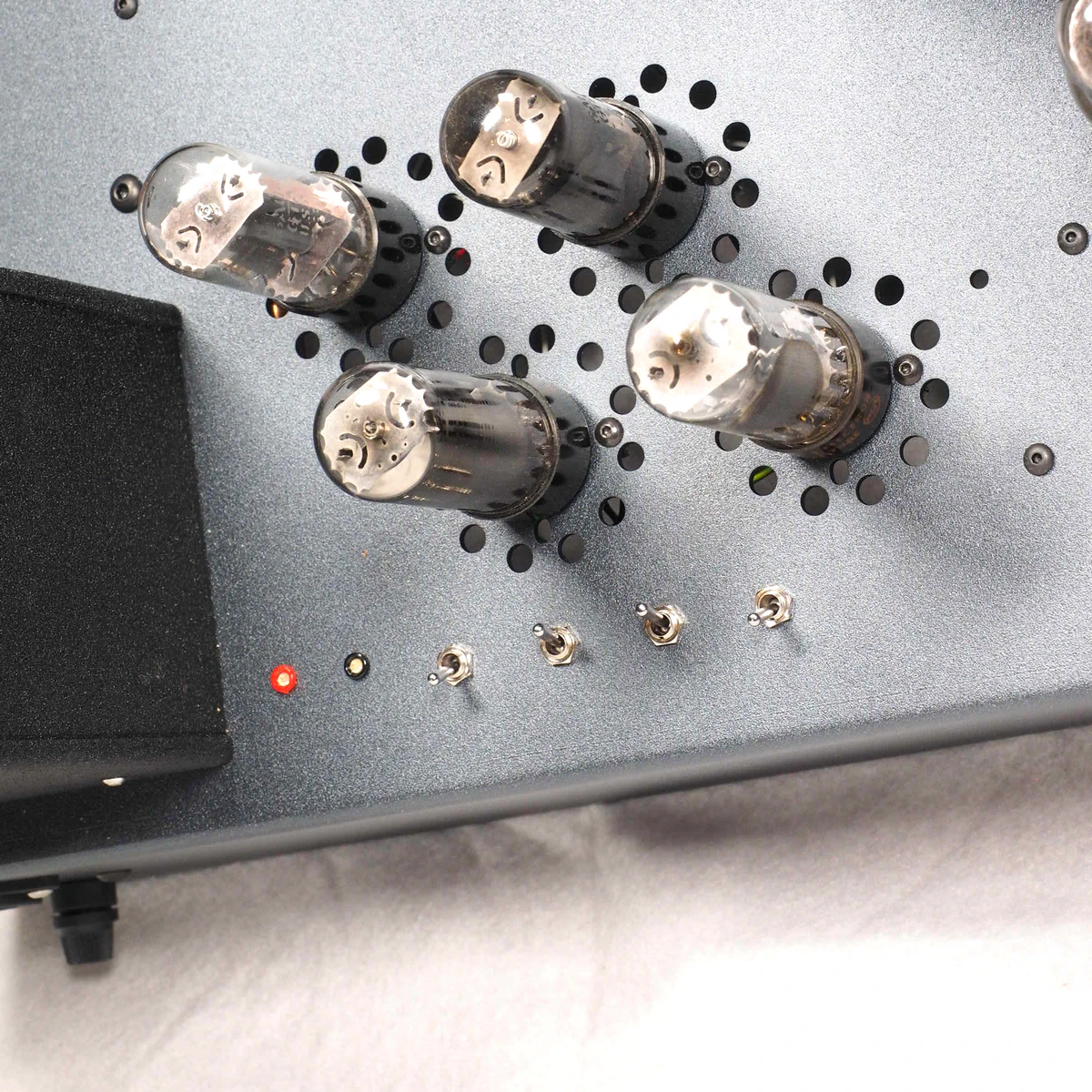
Filament Tuning Switches and Test Point (click to enlarge)
Mirror Imaged Pairs
We go to extra expense in support of implementing the shortest signal path from input jack to speaker terminal. This further contributes to an optimized layout and shortest possible cable lengths (both interconnect and speaker).
This circuit is so revealing that auditioning various samples of a 3″ length of wire was clearly audible during prototyping and development.
Onboard Power Supply
We're turntable guys and are always taking vibration into consideration. In theory, an outboard supply can reduce mechanical vibration from power transformers.
We considered implementing a 4 chassis design (external power supply for each monoblock), but prototyping showed us there was no free lunch.
Whenever we shortened wire paths (eliminating umbilicals) there was a sonic gain. This led us back to onboard power. We have found that a well-conceived vibration strategy coupled with quality transformers (Monolith) can address this on a single chassis by the use of a suspended subchassis.
The question remained: how to reduce self-generated noise in the chassis ...
Suspended Tube Subchassis
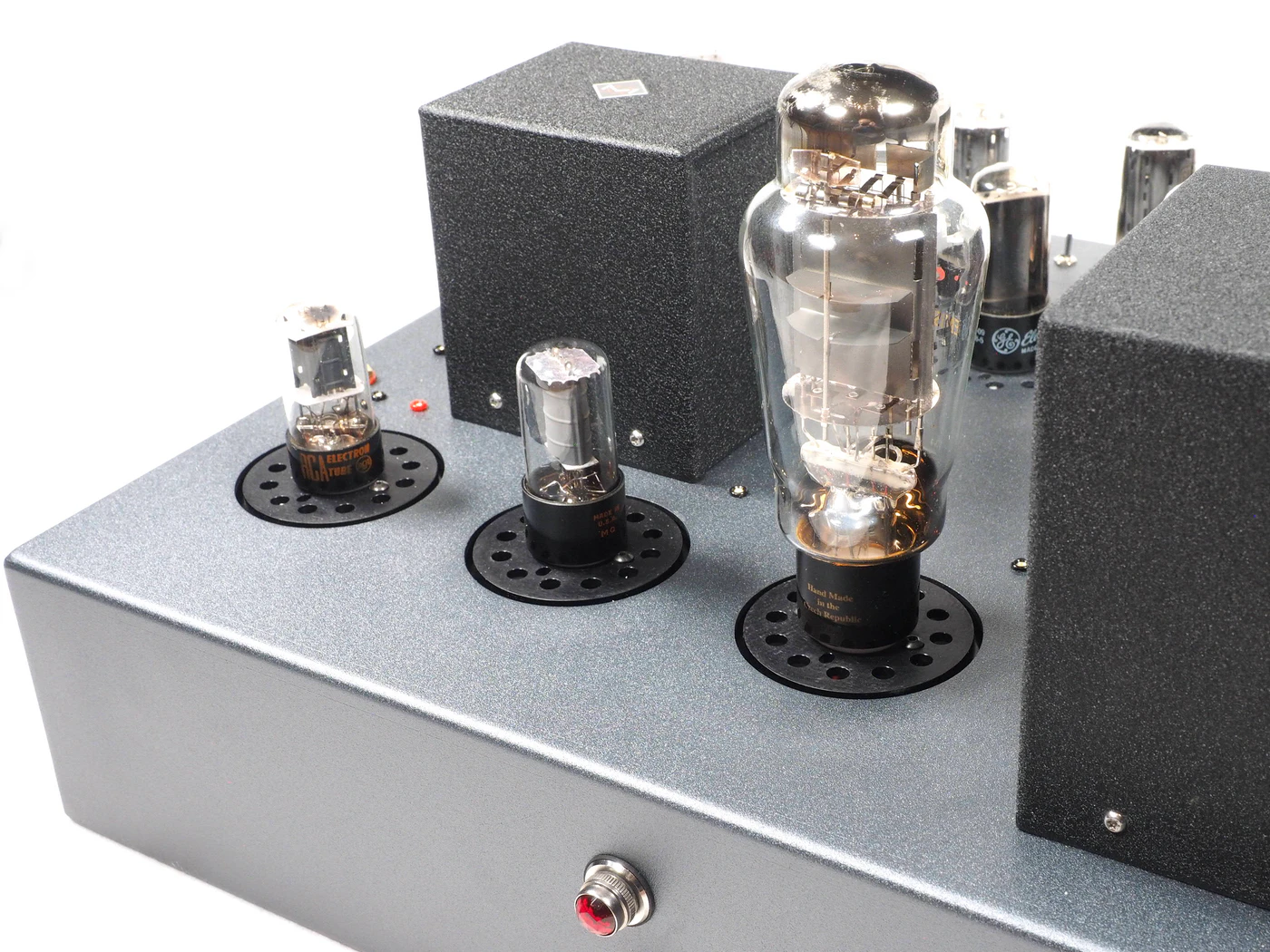
We developed a sub-chassis for the three signal tubes - suspended from the main chassis with custom, high-temperature isolation bushings.
This consolidation into a single chassis per channel was not a cost saving exercise.
Quite the opposite was the case, as this enhancement adds 25% to our chassis manufacturing expense.
Your custom isolation shelf and amplifier stand is most certainly welcome (as it addresses floor and stand-born noise), but amplifiers generate their own noise and our suspended subchassis addresses this yielding sonic returns.
Bonus! The lone coupling cap in the amplifier is also mounted to the sub-chassis.
Suspended Signal Tube Subchassis (click to enlarge)
A Rising Tide Raises all Ships
We have a working theory that great tonearms and great electronics raise the level of their associated components, while paradoxically making them sound more alike.
How can this be?
With high quality tonearms, their bearings, and energy management strategy make the cartridge's job much easier. This in turn minimizes the differences between cartridges while improving all of them to a greater or lesser extent.
With the NiWatts, we found relatively budget priced tubes sound much better than they have any right to. A good circuit, idealized layout, and careful parts specification matters!
Will the NiWatts sing a sweeter song with a pair of Western 300Bs? You betcha, but you'll be very surprised at what they can achieve with more modest tubes. We think this is a good thing.
Build Quality: "Roadie" Proof Construction
Turret board construction ensures immunity from physical shock. Click here for part-1 of our build log, with photos.
This is the same construction method used in guitar amplifiers which are ruggedized to survive decades of abuse from “roadies”.
Of course we went through countless turret board iterations until we were satisfied.
The relatively compact chassis layout doesn't compromise maintenance. Quite to the contrary, signal path is direct and intuitive, resulting in a layout which is easily serviceable. We expect this amplifier to be in service for multiple decades, and in conjunction with an optimized layout, robust construction was a key design criterion.
Parts Matter
Every part must justify its place in the NiWatt – from a 3″ length of wire, to the smallest resistor, and as noted above, the NiWatt is extremely responsive to parts changes.
The most expensive part was not necessarily the best suited to the task. For example, our NOS supply of Black Gate power supply capacitors did not fare as well as power supply capacitors which could easily have been overlooked if one specified parts based on price or "audiophile reputation".
Parts Obsolescence
While there's never a guarantee in this regard, we've future-proofed the design to the extent possible.
For example, we specified radial mount power supply capacitors. High quality axial capacitors becoming less and less available with each passing year.
Our DC filament supply for the 300B has no solid state components or custom circuits apart from the Schotky diodes in the bridge rectifier. We use standard resistors, capacitors (bypassed with film caps of course) and a common mode choke.
Premium Iron? Of Course!
Of course, many places in the circuit are demanding of premium parts, and it's no surprise that transformers are one such component.
The power transformer, interstage and output transformers are specified from Monolith Magnetics in Belgium. Their output transformer has a bandwidth of 7Hz to 151,000Hz.
You read that correctly: one-hundred-fifty-one-THOUSAND Hz. If you think this is only relevent to dogs and bats, you would be mistaken.
Coupling Capacitor
For the single coupling capacitor, choose from either the standard issue copper foil and beeswax, or either of the silver foil in oil coupling capacitors from Jupiter Condenser.
We intentionally left one coupling cap in the signal path so you can select from a rich palette of parts to voice the NiWatt to your taste.
We're happy to build with another capacitor of your choosing, but know that the Jupiters set an extremely high bar, and yes, we considered Duelands during our evaluation period!

Copper Foil (paper & wax)

Vitamin Q: Silver Foil (paper in oil)

Comet: Silver Foil (paper in oil)
Tube Sockets
Ceramic tube sockets for the signal tubes were selected for best mechanical contact.
Note the 6-finger collet construction: cup-shaped to match the radius of the tube pins and increase contact area (click photo to enlarge).

Octal & 4-Pin Tube Sockets
Circuit Topology
Dual Power Supplies:
We cover this above, and this element is key to the NiWatts' dynamic ease.
Damper diodes (tubes):
These are specified in place of conventional rectifiers.
Their high current capability conveys rhythmic speed and their reduced switching noise contributes to delicacy and nuance. Refer to the tube section for more details.
Three Stage Design: Input, Driver, and Output
We are firm believers in separate input and driver stages, because the input tube’s job (voltage gain) and driver tube’s job (current delivery) are very different.
Asking a single tube to perform both functions is like asking your BMW to haul a cord of firewood.
Input Stage (6SN7): Choke Loaded, Voltage Regulated, and RC coupled to the Driver
A classic circuit topology which has withstood the test of time.
We considered interstage transformers for this section. Ultimately, we came to appreciate the "tunability" of having one quality capacitor in the signal path. Choke loading the 6SN7 however was non-negotiable.
Shunt voltage regulation via a pair of VR105 tubes stabilizes the signal path at the beginning of the chain.
Driver (6V6): Interstage Coupled to Output Section
This is a perfect spot for an interstage transformer, and the Monolith iron with its extraordinary bandwidth fits the bill perfectly.
Phase inverting (3 gain stages)
An amplification (gain) stage (either a tube or a transistor) inverts phase, so an even number of stages is non-inverting and an odd number inverts phase. Simple, huh?
Tube Compliment
Rectification: damper diodes (4 tubes)
Choose from any of: 6AU4, 6AX4, 6CQ4, or 6DE4, but do not mix and match tube types!
- Traditional rectifiers (5AR4, 5U4G, etc.) are dual diodes (two diodes inside one tube).
- These damper diodes have a single diode, so the quad set in each amplifier is the electrical equivalent of two rectifier tubes ... only better!
- As noted above, the NiWatts have dual supplies to power the 300B separately from the input and driver sections. The two pairs of diodes satisfy this requirement.
Voltage Regulators: VR105 / OC3 (2 tubes)
- We specify two of these to regulate the input tube voltage to a constant 210 volts.
Signal tubes
- 1 6SN7 (input tube)
- 1 6V6 (driver tube) in triode mode
- 1 300B (output tube)
Selecting Your 300B
NiWatts were designed to be compatible with vintage and re-issue Western Electric 300B tubes. The amps are biased for 28 watt plate dissipation in accordance with best practices for Western Electric branded 300Bs.
This operating point is compatible with the vast majority of 300Bs in current production (there are a few exceptions).
You can run any variety of 300Bs as long as they specify the vintage correct heater current standard of 1.2 amps. Most Emission Labs tubes are manufactured to this standard as are (of course) the re-issue Western Electric 300Bs.
Contact us for advice.
The musical benefit of damper diodes
Most individuals are unfamiliar with damper diodes. They have much lower switching noise. This translates into a less “hashy” sound - better than even the best new old stock rectifiers.
They also have much higher current capability than normal rectifiers. All things being equal, damper diodes follow musical transitions with more finesse and speed.
Damper diodes are in plentiful supply in new old stock, and as an added bonus, they are priced lower than what you’d pay for current production 5AR4’s from Sovtek, JJ etc.
How does it get better than that?
Introductory Pricing - $24,995
Price includes:
A $500 travel rebate:
If you visit Galibier to audition and purchase a NiWatt within one year of your visit, we'll credit your purchase by this amount. Visit Colorful Colorado on our dime!
Free Power and Speaker Cables:
NiWatts are delivered with two Wind River Power Cables and a single-wire set of our Wind River Speaker Cables. Maximum length for the power cables is 8 feet and for the speaker cables 10 feet. Longer cables are extremely difficult to manufacture.
If you have already purchased any Wind River Galibier cables in the past, we’ll credit you for the price you paid for any three cables. Credit is for the price paid, less tax and shipping.
Cable notes:
These cables are not “throw-ins”. They were instrumental in the prototyping and development of the NiWatts. We needed better tools, so we had to design them.
